



Luxor Attractions, Weather & Tips
Who Luxor Egypt If you truly want to understand it, you don’t need a city map. A glance at the sky is enough. Every morning, the sun rises over the eastern bank, where the pharaohs built their temples for the living. It travels across the Nile, bathing the sugarcane fields in green gold, and sinks in the evening behind the Theban mountains to the west, where the kings of Egypt found their eternal rest. The ancient Egyptians oriented their entire city according to this path of the sun. That is exactly how we would like to show you Luxor, Egypt present: not as a list of ruins, but as a single day that began 3,500 years ago and has not yet come to an end.
Luxor is a city where a farmer walks past a sphinx with his donkey, as if it were the most normal thing in the world. On the banks of the Nile, children play soccer while temple columns rise behind them into the evening sky. About one-third of the most significant monuments of antiquity are located here, spread across two banks and connected by a river. This travel guide will accompany you from the first light of dawn to the last shadow of dusk.
Luxor, Egypt at a Glance: Location and How to Get There
Luxor, Egypt, is located about 670 kilometers south of Cairo, in the heart of Upper Egypt. The Nile divides the city into two distinct worlds. On the lively east bank, you’ll find hotels, the souk, the train station, and the great temples. The quiet west bank is home to sugarcane fields, mud-brick villages, and the pharaohs’ necropolises. The ferry ride takes barely ten minutes and costs less than a cup of coffee in Zurich.
For travelers from Switzerland, getting there is straightforward. Most routes go through Cairo, from where domestic flights reach Luxor in just over an hour. A popular option is to combine this trip with a visit to the Red Sea: From Hurghada, you can reach the city in about four hours by road. Those who enjoy a touch of nostalgia can take the overnight train from Cairo and wake up surrounded by palm trees and fields. The time difference with Switzerland is only one hour all year round.
From Waset to the “City of Palaces”
The ancient Egyptians called their city Waset; the Greeks later called it Thebes, the “City of a Hundred Gates,” which even Homer raved about. During the New Kingdom (ca. 1550–1070 B.C.), Thebes was the religious and political center of a world empire that stretched from Sudan to Syria. The god Amun rose to become the most powerful god in the land, and every pharaoh wanted to add another pylon, another hall, or another obelisk to his temple.
The city owes its current name to the Arabs: “al-Uqsur” means “the palaces.” That’s how imposing the temple ruins appeared to travelers in the Middle Ages. In 1979, UNESCO designated ancient Thebes, along with its Valley of the Kings, as a World Heritage Site. Archaeologists continue to excavate to this day: In 2021, the so-called “Golden City” from the time of Amenhotep III was unveiled on the west bank—one of the most spectacular discoveries in Luxor, Egypt, since Tutankhamun.
In the morning: Luxor sights on the West Bank
The ancient Egyptians buried their dead where the sun set. For visitors, however, the best approach is to start on the west bank—and to start early. Between 7:00 and 10:00 a.m., the light is soft, the air is pleasant, and the crowds are manageable.
Hot-Air Balloon Ride at Sunrise
Even before dawn, dozens of hot-air balloons take off and float silently over temples, fields, and desert mountains. From above, you can see just how sharp the boundary is between lush greenery and golden sand. In ancient Egypt, this line determined life and death. Many of our guests call the hot-air balloon ride the most beautiful moment of their entire trip.
Valley of the Kings
Behind a barren mountain range, whose summit resembles a natural pyramid, lies the Valley of the Kings. More than 60 tombs have been carved into the rock here, including those of Ramses II, Sethos I, and Tutankhamun, whose treasures Howard Carter discovered in 1922. Deep within the mountain, colors over 3,000 years old still shine: starry skies, divine barques, and scenes from the Book of the Dead. The standard ticket allows you to visit three tombs. For Tutankhamun, Seti I, and Ramses VI, you’ll need additional tickets. We recommend the tomb of Seti I, the longest and arguably the most magnificent in the Valley of the Kings.
Temple of Hatshepsut
At the foot of the cliff face at Deir el-Bahari, the Temple of Hatshepsut rises in three large terraces. The woman who had herself crowned pharaoh created here a structure of almost modern clarity. Take note of the reliefs depicting the expedition to the legendary land of Punt, featuring incense trees, exotic animals, and foreign ships.
The Colossi of Memnon, Medinet Habu, and the Valley of the Queens
On the way back to the Nile, the Colossi of Memnon—two seated statues of Amenhotep III, each about 18 meters tall—greet visitors. Medinet Habu, the temple of Ramses III, features some of Egypt’s best-preserved polychrome reliefs and is often underappreciated. In the Valley of the Queens, Nefertari’s tomb awaits. It is accessible only with a special ticket and during limited visiting hours, but it is worth every franc.
At noon: Find some shade, just like the locals do
When the sun is at its zenith, the whole of Luxor takes a break, and you should too. The midday hours are perfect for visiting the Luxor Museum on the Corniche. The small, thoughtfully curated collection showcases masterpieces without the crowds, including statues discovered in 1989 in a hiding place beneath the Luxor Temple and the mummies of two pharaohs. Right next door, the Mummification Museum explains how the Egyptians prepared their dead for eternity. Afterward, enjoy a fresh mango juice, a plate of koshari, and an hour of relaxation in the hotel garden.
In the evening: Karnak Temple and Luxor Temple on the east bank
As the heat subsides, life returns to the East Bank. Now Luxor’s most famous sights are at their most beautiful.
Karnak Temple: A Forest of Stone
The Karnak Temple is not a single building, but a temple complex that was under construction for about 2,000 years. Pylons, obelisks, chapels, and a sacred lake are arranged in a row. At its heart lies the great hypostyle hall with 134 massive columns, the central ones over 20 meters high. Standing among them and tilting your head back, you suddenly feel very small—and that was exactly what the builders intended. In the evening, the sound-and-light show transforms the Karnak Temple into a stage brimming with history.
Sphingenallee
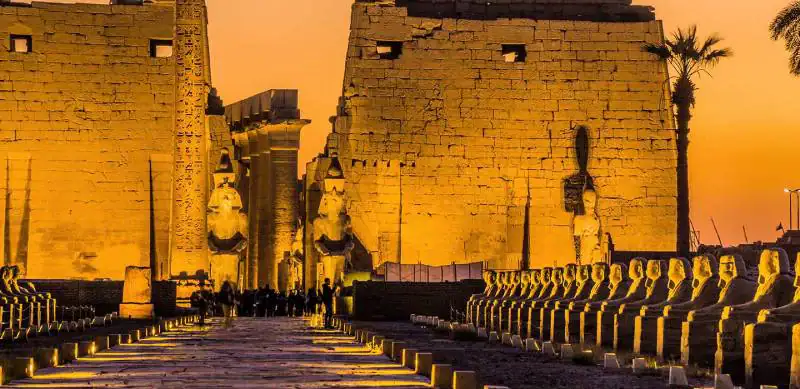
The Avenue of the Sphinxes, approximately 2.7 kilometers long, connects the Karnak Temple with the Luxor Temple. For centuries, it lay buried beneath houses and streets. Since its grand reopening in 2021, you can once again stroll along the processional route where the statues of the gods were once carried during the Opet Festival.
Luxor Temple: The Sanctuary in the Heart of the City
The Luxor Temple is the perfect way to end your day. It was built primarily during the reigns of Amenhotep III and Ramses II and stands right on the Nile in the city center. A single obelisk rises up in front of the entrance. Its twin now stands on the Place de la Concorde in Paris. In the midst of the ruins stands the Abu Haggag Mosque, whose door now hangs at a lofty height because the temple beneath it was only uncovered later. After dark, the Luxor Temple glows golden—a sight that will stay with you for a long time.
Luxor Weather and Best Time to Visit
The weather in Luxor is characterized by one thing above all else: sunshine. It practically never rains, and the sun shines for up to twelve hours a day. The ideal time to visit is between October and April. In winter, daytime temperatures reach a pleasant 22 to 26 °C, but at night it can cool down to 5 to 8 °C, so be sure to pack a warm jacket. From June through August, the temperature regularly rises above 40 °C. Those who travel during this time will enjoy empty temples and lower prices, but should plan their sightseeing for the early morning hours.
December through February: Pleasant temperatures ranging from 22 to 26 °C during the day, cooling down to 5 to 8 °C at night. This is the perfect time for long days of cultural exploration. Be sure to pack a warm jacket for the evenings and the early-morning hot-air balloon ride.
March through April and October through November: With daytime temperatures ranging from 28 to 35 °C and nighttime temperatures from 13 to 20 °C, you can expect warm, long, and sunny days. Ideal for travelers who like it warm but not hot.
May through September: Temperatures reach 38 to 42 °C, and nights remain warm at 22 to 27 °C. This time of year is recommended only for travelers who can handle the heat, who set out early and spend the midday hours in the shade.
If you keep an eye on the weather in Luxor while planning your trip, you can choose the season that best suits your travel style. Winter is ideal for days spent exploring temples, while late summer is perfect for visiting monuments at a leisurely pace and enjoying relaxing days on the Nile.
Luxor in 4 Days: Our Suggested Itinerary
Day 1: Arrival and First Glimpse of Luxor, Egypt
After arriving and checking in, the afternoon is intentionally kept low-key. Take a stroll along the Corniche, watch the feluccas with their white sails, and let the pace of Luxor, Egypt, wash over you. At sunset, visit the illuminated Luxor Temple, which is just a few minutes’ walk from most hotels. Dinner on a rooftop terrace overlooking the Nile rounds out the first day.
Day 2: The West Bank of Luxor, Egypt
Early in the morning—or after a hot-air balloon ride, if you’d like—you’ll cross over to the West Bank. The first stop is the Valley of the Kings, where you’ll visit three tombs of your choice and, optionally, Tutankhamun’s tomb. Next, you’ll visit the Terrace Temple of Hatshepsut and the Colossi of Memnon. After lunch at a guesthouse nestled among the fields, you’ll visit Medinet Habu. In the late afternoon, you’ll sail back to the east bank on a felucca. There’s hardly a more intense day to be had in Luxor, Egypt.
Day 3: Karnak Temple and the Heart of the City
Spend the morning at the Karnak Temple. Allow at least three hours to explore the site, from the first pylon through the Great Hypostyle Hall to the Sacred Lake. At noon, visit the Luxor Museum, followed by a stroll through the souk, where you’ll find spices, alabaster, and hand-woven scarves. In the evening, return to Karnak for the sound-and-light show, and you’ll understand why Luxor was once considered the City of the Gods in Egypt.
Day 4: Dendera or the start of your Nile cruise
For your last day, you have two wonderful options. You can either drive a little over an hour north to the Temple of Hathor at Dendera, with its famous blue star ceiling. Or you can board a Nile cruise ship in Luxor, Egypt, and travel upriver toward Aswan.
Nile Cruises from Luxor: The River as Your Guide
Many of the most beautiful Nile cruises begin or end in Luxor. On the classic route to Aswan—which lasts three to four nights, depending on the itinerary—you’ll glide past palm groves and mud-brick villages. You’ll pass through the Esna Lock and visit the Temple of Horus at Edfu as well as the Double Temple at Kom Ombo. On board, life follows the rhythm of the river: breakfast on deck, morning sightseeing, and tea at sunset. Those who prefer a more intimate experience can choose a dahabiya, a traditional sailing ship with just a few cabins that also docks at small islands. Our Nile cruises combine Luxor’s sights with the tranquility of the river and can be flexibly combined with Combine it with Cairo or the Red Sea.
Practical Tips for Travelers from Switzerland
Clothing: Light, loose-fitting clothing that covers the shoulders and knees is appropriate in temples and mosques and provides protection from the sun. Sturdy shoes are a must, as you’ll be walking several kilometers each day in the Valley of the Kings and at Karnak.
Money and Tips: The local currency is the Egyptian pound. Small bills are worth their weight in gold when it comes to tipping. You can usually pay for tickets to major attractions by card.
On the Go: On the west bank, the cooler months are a wonderful time to bike between villages and landmarks. A horse-drawn carriage ride along the east bank in the evening is charming. Be sure to agree on the price in advance, though.
Frequently Asked Questions About Luxor, Egypt
How many days should you plan for Luxor?
You’ll need at least two full days to see Luxor’s main attractions. With three to four days, you can explore both banks at a leisurely pace.
When is the best time to visit?
From October through April, the weather in Luxor is ideal for sightseeing. December through February is peak season.
Is it worth taking a day trip from Hurghada?
Yes, but it’s a long and intense day. If you want to see more than just the highlights, you should plan on staying at least one night.
Can I combine a visit to Luxor with a Nile cruise?
Absolutely. Most Nile cruises depart from Luxor, and spending one or two days there before boarding is the perfect way to round out your trip.
Your trip to Luxor, Egypt, begins here
You don’t just visit Luxor —you experience it in tune with the sun: in the morning with the kings in the west, in the evening with the gods in the east. Whether as a city break, the highlight of a tour, or the start of a Nile cruise, we at Adam Travel will tailor your trip to Luxor, Egypt, exactly to your wishes, with personalized advice from Switzerland and experienced local tour guides. Contact us for a no-obligation quote. The sun over the Nile is already waiting.