



Aswan Attractions: A City in the Colors of Nubia
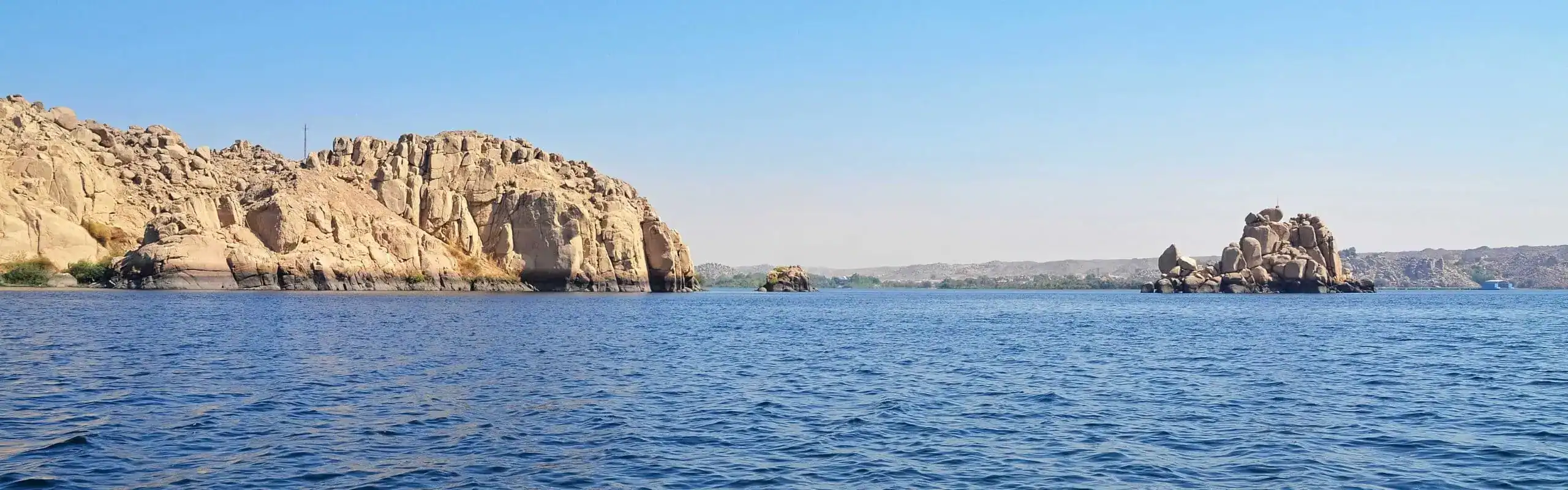
Some cities have a color. Aswan has them all. There’s the deep blue of the Nile, which winds its way here between black granite cliffs. There’s the white of the felucca sails, the pink of the quarries, and the lush green of the palm-fringed islands. Behind them, the desert glows gold, stretching all the way to the water’s edge. And then there are the Nubian villages, whose houses are painted in turquoise, yellow, and ochre, as if someone had spilled a box of paints along the riverbank. It is precisely these colors that make Aswan’s sights so distinctive.
Anyone coming here from Luxor or Cairo will feel it right away: the pace slows down, the air becomes clearer, and the smiles get wider. You don’t just check off Aswan’s sights —you savor them. This Aswan travel guide takes you, step by step, through the deep south of the country, to where Egypt meets Nubia.
Aswan, Egypt: The Gateway to Nubia
Aswan is located about 900 kilometers south of Cairo and about 210 kilometers upstream from Luxor. This is where the first Nile cataract once stood—a series of rapids formed by granite boulders that were nearly impassable for ships. For millennia, this natural boundary marked the end of Egypt and the beginning of Nubia. It’s no wonder that Aswan became a trading hub: gold, ivory, frankincense, and ebony from Africa changed hands here. Many of Aswan’s sights still tell the story of this era today. The ancient name of Elephantine Island, “Abu,” simply means “elephant” and is a reminder of the ivory trade.
Getting there is easy. From Cairo, it’s about a one-and-a-half-hour flight to Aswan. From Luxor, you can reach the city in about three hours by car or, for a touch of elegance, by boat. As is the case throughout Egypt, the time difference from Switzerland is only one hour.
Blue: Aswan Attractions Along the Nile and on the Islands
The heart of Aswan beats on the water. Nowhere else in Egypt is the Nile as beautiful as it is here, where it winds its way around small islands and smooth, polished rocks. The best way to experience it is on a felucca ride. These traditional sailboats glide almost silently across the water while the captain softly hums Nubian songs.
On Elephantine Island, you’ll stroll through two Nubian villages with narrow, shaded alleys. The ruins of the Temple of Khnum and one of Egypt’s oldest nilometers tell the story of how the priests once measured the water level here and used it to calculate taxes for the entire country.
Right next to it lies Kitchener Island with its botanical garden, a green oasis filled with exotic trees from Africa and Asia. On the west bank, high above the river, stand the rock-cut tombs of the princes (Qubbet el-Hawa). The climb is strenuous, but the view over the Nile, the islands, and the desert is one of Aswan’s most beautiful sights.
Pink: The Granite That Conquered the World
Aswan’s second color is the warm pink of its granite. The quarries surrounding the city are the source of the obelisks at Karnak, the sarcophagi in the Valley of the Kings, and many statues that are now on display in museums around the world.
Hardly any of Aswan’s sights showcase the art of stonemasonry as impressively as the Unfinished Obelisk. Construction likely began under Queen Hatshepsut, and at a height of about 42 meters, it would have been the largest obelisk of all time. However, a crack formed in the stone during construction, and the project was abandoned. It remains embedded in the rock to this day, and you can see the tool marks with your own eyes.
The famous Old Cataract Hotel on the banks of the Nile also glows pink. Since 1899, it has welcomed kings, statesmen, and writers. Agatha Christie found inspiration here for *Death on the Nile*. Enjoying a cup of tea on the terrace at sunset is a little ritual you should treat yourself to, even if you’re not staying at the hotel.
Turquoise: Philae, the High Dam, and Lake Nasser
South of the city, the water changes color. This is where the dam’s domain begins, and the Nile becomes a turquoise lake. This area is home to some of Aswan’s oldest—and at the same time, most modern— attractions.
Philae Temple: The Island of Isis
The Temple of Philae is dedicated to the goddess Isis and is one of Aswan’s most romantic attractions. It can only be reached by boat, and even the journey there—as the columns slowly rise out of the water—is unforgettable. The ancient religion was practiced here longer than anywhere else: The world’s last known hieroglyphic inscription dates back to 394 A.D. When the construction of the dam threatened to flood the island, the entire temple was moved, stone by stone, to the higher-lying island of Agilkia in an international rescue operation.
The High Dam and Lake Nasser
The Aswan High Dam was built between 1960 and 1970 and is about 3.6 kilometers long. It protects Egypt from floods and droughts and provides electricity to millions of people. Behind it lies Lake Nasser, one of the world’s largest artificial lakes, stretching about 500 kilometers in length and extending partly into Sudan. The Temple of Kalabsha also stands on the shore of Lake Nasser; it, too, was saved from the floodwaters and relocated here.
Gold: The Abu Simbel Temples on the Edge of the Desert
No other excursion caps off a tour of Aswan’s sights quite like this one. About 280 kilometers south of the city, in the heart of the golden desert and right on Lake Nasser, stand the Abu Simbel Temples. Ramses II had them carved into the rock in the 13th century B.C. Four colossal statues of the pharaoh, each 20 meters tall, guard the Great Temple, while a smaller temple next to it honors his beloved wife, Nefertari.
In the 1960s, as part of a massive UNESCO rescue operation, both temples were dismantled into over a thousand blocks and rebuilt approximately 65 meters higher. Twice a year, around February 22 and October 22, the light of the rising sun shines deep into the interior of the temple and illuminates the statues of the gods in the innermost sanctuary. This solar phenomenon attracts visitors from all over the world.
You can reach the Abu Simbel Temples from Aswan in about three and a half hours by car or in about 45 minutes by plane. An even more impressive way to get there is on a cruise across Lake Nasser.
Also set against a backdrop of golden desert hues, the Monastery of St. Simeon is located on the western shore. This early Christian monastery dates back to the 7th century and is best reached on the back of a camel.
Colorful: Nubian Life, Museum, and Souk
The most cheerful sights in Aswan aren’t monuments, but people. In villages like Gharb Sehel, the domed houses glow in shades of blue, yellow, and pink, and the walls are painted with palm trees, camels, and geometric patterns. You can drink hibiscus tea in a Nubian house, get a henna tattoo, and marvel at the crocodiles that some families traditionally keep as good-luck charms.
If you want to understand the history behind this culture, visit the Nubian Museum. It offers a compelling account of the millennia-old civilization of Nubia and the villages that were submerged in Lake Nasser. To round off the visit, the Aswan souk entices visitors with spices, dates, baskets, and the scent of incense.
Aswan Weather and Best Time to Visit
Aswan is one of the driest and sunniest cities in the world. It almost never rains here.
October through April: This is the ideal time to visit. During the day, you can expect pleasant temperatures ranging from 23 to 30 °C; at night, temperatures drop to around 10 °C in winter. It’s the perfect time to explore all of Aswan’s sights at a leisurely pace, including felucca rides and a trip to Abu Simbel.
May through September: Temperatures often rise above 40 °C. If you’re traveling during this time, plan your sightseeing for the early morning hours and spend the midday in the shade or by the pool.
Aswan Attractions in 4 Days: Our Suggested Itinerary
Day 1: Arrival and the Blue of the Nile
Upon your arrival, you’ll spend your first afternoon exploring Aswan’s sights from the water. A felucca will take you past Elephantine to Kitchener Island, where you’ll stroll among the palm trees in the botanical garden. As the sun sets, you’ll sail back and enjoy a cup of tea on the terrace of the Old Cataract Hotel while the granite cliffs begin to glow pink.
Day 2: Granite, the Dam, and the Island of Isis
In the morning, you’ll visit the Unfinished Obelisk and learn how the pharaohs carved their monuments out of the rock. The tour continues to the High Dam, which offers a view of Lake Nasser. Afterward, you’ll take a boat ride to the Temple of Philae, the most atmospheric of Aswan’s attractions. In the evening, you’ll stroll through the souk or enjoy the sound-and-light show at Philae.
Day 3: Trip to the Abu Simbel Temples
Today you’ll be getting up early. Before sunrise, you’ll drive or fly to Abu Simbel and stand before the highlight of all Aswan’s sights: the colossi of Ramses II, as the desert glows golden in the first light of day. After touring both temples, you’ll return to Aswan, Egypt, in the afternoon. The evening is free for you to relax.
Day 4: Nubian Colors and Farewells, or Continuing the Journey
Spend your last day exploring Aswan’s most colorful sights. Take a boat to Gharb Sehel, where you’ll be a guest in a brightly painted house. In the afternoon, you’ll visit the Nubian Museum. For many guests, this marks the beginning of a new chapter: they’ll board a Nile riverboat bound for Luxor or set out on a cruise on Lake Nasser.
Nile Cruise: Aswan to Luxor—The Most Beautiful Route North
The classic Nile cruise from Aswan to Luxor lasts three to four nights and is one of the world’s greatest travel experiences. Along the way, you’ll visit the Double Temple of Kom Ombo, dedicated to two gods, as well as the Temple of Horus at Edfu, one of Egypt’s best-preserved temples. In between, you’ll enjoy days of tranquility: palm groves, fishing boats, and villages glide past the deck.
If you’re looking for something even more exclusive, choose a dahabiya, a traditional sailing ship with just a few cabins. And if you’re seeking something completely different, book a cruise on Lake Nasser that docks right in front of the Abu Simbel Temples. Every Nile cruise from Aswan to Luxor combines the sights of Aswan with the tranquility of the river and can be flexibly combined with Cairo, Luxor, or the Red Sea through us.
Practical Tips for Your Trip
Clothing: Light, loose-fitting clothing that covers the shoulders and knees is appropriate in temples and villages. For cool winter mornings—especially on the trip to Abu Simbel—you should pack a warm jacket.
Feluccas and boats: Agree on the price before the trip. The best times to be on the water are in the late afternoon and at sunset.
Money: Small Egyptian pound bills are essential for tips. You can usually pay for tickets to major attractions with a credit card.
Frequently Asked Questions About Aswan’s Attractions
Which sights in Aswan are must-sees?
The Temple of Philae, the Unfinished Obelisk, a felucca ride to the Nile islands, a Nubian village, and, of course, the Abu Simbel Temples.
How many days should you spend in Aswan?
You’ll need two days to see Aswan’s main attractions. If you include a trip to Abu Simbel, we recommend three to four days.
Is the trip to Abu Simbel worth it?
Absolutely. The Abu Simbel Temples are among the most impressive monuments in the world and are worth every minute of the journey.
Is it possible to combine a visit to Aswan with a Nile cruise?
Yes. Most Nile cruises start or end in Aswan, and cruises on Lake Nasser also begin here.
Is Aswan a good place for families?
Very much so. Boat rides, camel rides, and the colorful Nubian villages delight children just as much as adults.
Your journey to the sights of Aswan begins here
Aswan is the city where Egypt finds its most beautiful peace. Here, you’ll sail among islands, stand before the colossi of Abu Simbel, and enjoy tea in a Nubian home. Whether as the highlight of a tour through Aswan and Egypt, as the start of a Nile cruise, or as a standalone getaway in the south: We at Adam Travel will guide you to Aswan’s sights, tailored entirely to your wishes and with personalized advice from Switzerland. Contact us for a no-obligation quote and discover the colors of Nubia for yourself.